
Replacing an AC fan coil motor with an EC motor is usually treated as a rewiring project, which is why so many units are left alone. It does not have to be. A three-speed EC motor connects to the same four wires as the motor it replaces — one neutral, three switched lives — and changes speed the way the old thermostat already does. No control cable, no new controller, no commissioning.
What drop-in actually means
Three things have to be true before a motor can be called a drop-in replacement, and a three-speed EC motor meets all three:
- Same supply. Mains in, no separate control supply and no signal cable.
- Same switching. Three switched lives selected by the unit’s existing speed selector or thermostat.
- Same mechanical interface. Frame, shaft and mounting bracket matching the motor being removed.
Where any of those fail, the job stops being a motor swap and becomes a modification of the unit. That is worth knowing before you order, not after.
Why so many EC retrofits turn into projects
Three obstacles come up repeatedly:
The unit has no control signal. A 0–10 V input has to come from somewhere. On a fan coil unit built in the 2000s there is usually no controller to provide it, and adding one costs more than the motor.
The wiring has to change. Standard EC motors take a permanent live plus a signal. The existing unit switches the live to select speed. Rewiring the terminal block is a job for an electrician, and it changes a unit that was certified as built.
There is nowhere to put the drive. External-drive EC motors need a box mounted beside the motor, inside a ceiling void that was never sized for it.
A three-speed EC motor with the drive integrated into the housing avoids all three. That is the whole point of the design.
The four wires
| Wire | Function |
|---|---|
| Yellow | Neutral |
| Red | Switched live — one speed |
| Blue | Switched live — one speed |
| Black | Switched live — one speed |
Which switched live is high, medium and low is marked on the controller label. Check it before connecting: a mis-ordered connection gives the right three speeds in the wrong positions, which shows up as a unit that runs high when the thermostat asks for low — and is usually blamed on the motor.
Before disconnecting the old motor, label every wire and photograph the terminal block. The old motor’s three lives correspond one-to-one with the new one’s; the neutral is shared. There is no fourth speed and no wire to leave spare.
What has to match mechanically
This is where retrofit projects actually fail, and none of it is electrical. Confirm all six before ordering, using a drawing of the AC fan coil motor you are removing rather than a photograph.
- Frame diameter and body length
- Shaft diameter, length, and whether it is a D-cut or a keyway
- Bracket hole spacing and mounting orientation
- Direction of rotation — a motor that runs backwards will be returned
- Lead length and exit side, and whether the cable will reach the terminal block
- Clearance where the drive housing sits, if the old motor had an external capacitor box in that space
A drawing answers all six. A photograph does not.
Remove the capacitor
The old motor has a run capacitor bolted to the bracket or sitting in the terminal box. The EC motor does not use one, and it must come out of the circuit, not be left connected “just in case”. Leaving it in is the single most common installation error on this swap, and it can cause the motor to fault or run erratically.
Take the opportunity to remove the bracket too, if the new motor mounts without it. Every component left in a ceiling void is one more thing to fail.
What the remote control adds
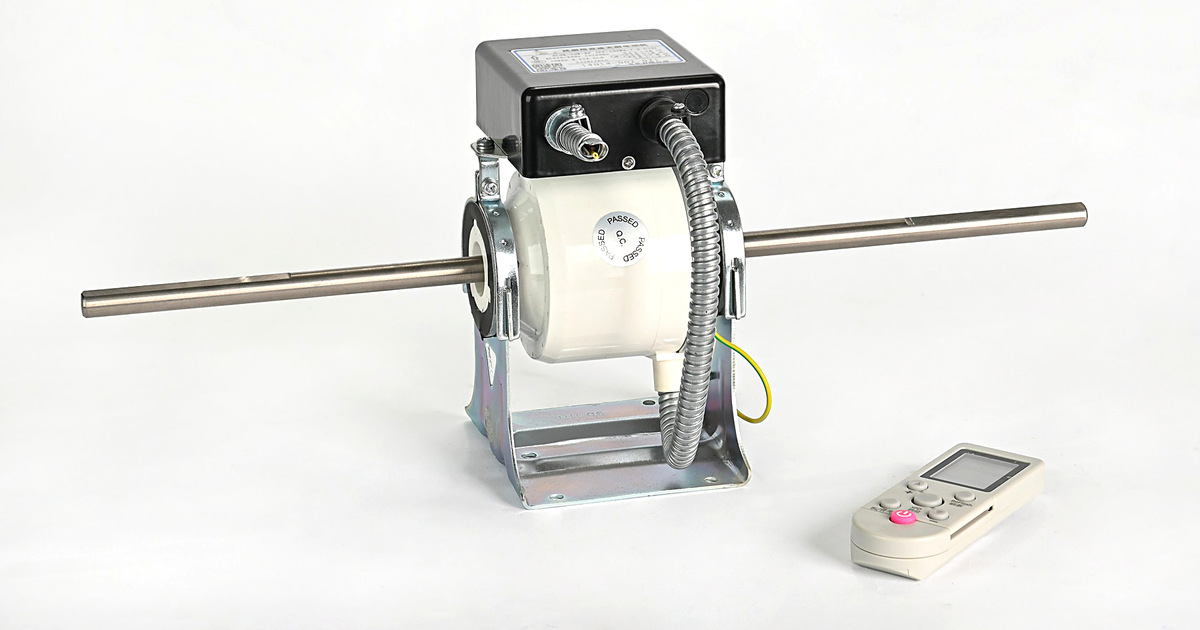
The three-speed version is set up from an infrared remote rather than a control cable, which is what makes it usable in a unit with no spare wiring. On our resin-packed range it covers:
- Speed within each tap, continuously adjustable from 300 to 1,500 rpm
- Direction of rotation
- Load inertia, so the drive can be matched to the wheel it is turning
- Constant speed or constant torque operation
That adjustability is what makes a retrofit practical: the unit can be trimmed to the airflow it was originally commissioned at, rather than accepting whatever the nearest tap happens to give.
The last one matters more than it sounds. In constant speed the motor holds its set rpm as the filter loads and the static pressure rises — the airflow stays where it was set. In constant torque the output torque follows the speed setting instead, so the motor behaves closer to the induction motor it replaced and the airflow falls away with load in the way the original unit was designed around. Matching the mode to the application is often the difference between a unit that behaves as before and one that suddenly delivers more air than the duct was sized for.
What it does to the electricity bill
The reason to do this swap at all is the part-load behaviour. On a 600 CFM unit at 12 Pa, our three-speed EC motor drew 52 W at high speed where the AC motor drew 96 W, 26 W against 84 W at medium, and 13 W against 70 W at low. The lower the speed, the larger the gap — which is the band where most units actually run.
We have written the full comparison, including the payback arithmetic and the cases where an AC motor is still the better answer: PSC vs EC motor for fan coil units.
Questions we get about replacing an AC fan coil motor
Q: Do I need to change the thermostat or the speed selector?
A: No. The motor is switched by the same three lives the old motor used, so whatever selects speed today still selects speed afterwards.
Q: Can I keep the old capacitor connected?
A: No. The EC motor does not need it and should not have it in circuit. Remove it and its bracket.
Q: Will the unit deliver the same airflow as before?
A: Yes. The EC motor holds its set speed where the AC motor sagged under load, so on the same tap the unit may move slightly more air — and because each tap is adjustable from 300 to 1,500 rpm on the remote, you can trim it on site to reproduce the original airflow exactly.
Send us the old motor, not the unit model
The fastest way to get this right is a drawing of the motor you are removing — shaft, bracket hole spacing and lead exit — plus the supply voltage and the speed selection the unit uses. Send that and we will confirm the match against the resin-packed EC range or the standard EC range before anything is ordered. The mechanical checks in How to choose a fan coil unit motor are the same list we will run through.